General status
Payment status code (e.g. ACSP, ACCC) and its plain-language wording.
The Telegram assistant, extended payment details, and the technology behind monitoring.
Check payment status, request available Extended details, and receive status-change notifications with an eligible tracking plan. The bot has a separate free allowance.
Open @swiftgpibot ↗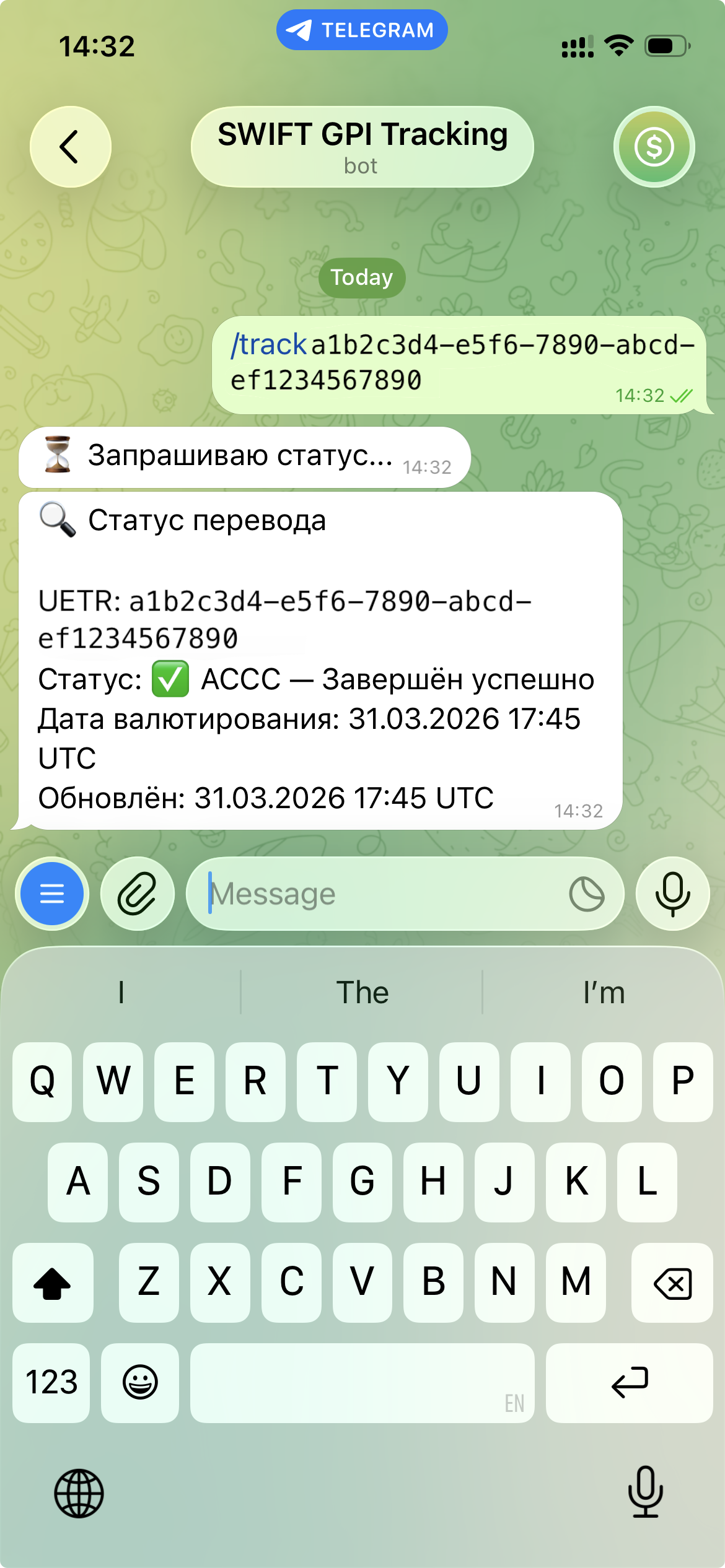
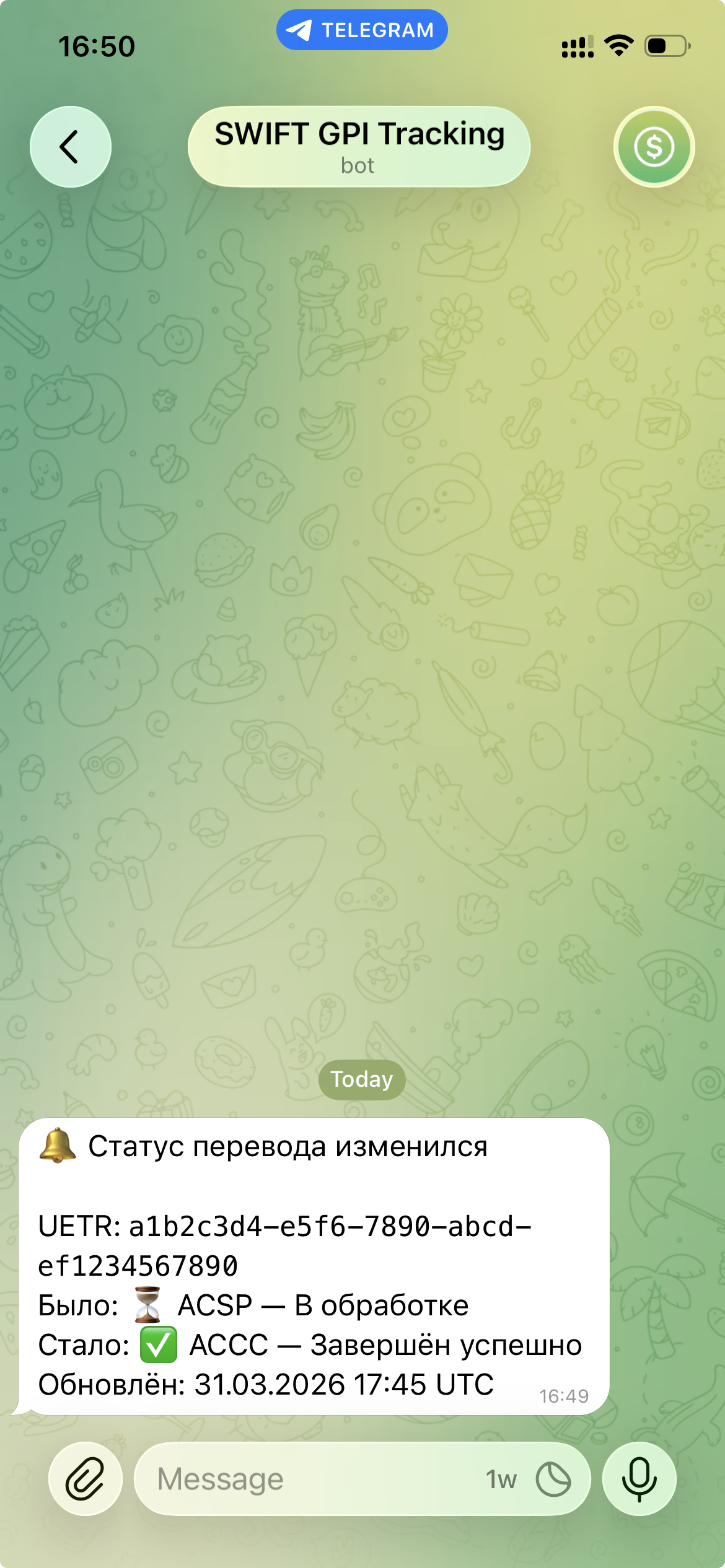
Adaptive monitoring
The frequency of checks gradually decreases as a transfer gets older: hourly at first, then every three hours, then every six hours. Monitoring stops at the final status, with confirmation handling for rejected and refunded payments.
Live scheduled intervals by payment age, based on the value date where available. Source availability can affect individual checks; new banking events are not guaranteed.
Availability of each group of details depends on the specific payment. Full data for every payment is not guaranteed.
Payment status code (e.g. ACSP, ACCC) and its plain-language wording.
Payment date, value date and the last known update of the payment itself.
Sent amount and settlement amount where available. Different amounts are different kinds of values and do not always match.
Banks confirmed by payment events. Not every participant in the chain is necessarily displayed.
Chronology of known events and additional processing information for one UETR.
Reported charges where available. Components are not summed automatically.
A tool that saves hours of waiting and nerves on international transfers
Track transfers regardless of the sending bank. No online banking access is needed — only the UETR.
The answer usually arrives within seconds. If no information is available, an additional search with your payment details is possible in the bot.
Paid monitoring checks approximately every 1 hour during days 0–7, every 3 hours during days 8–30 and every 6 hours afterwards, and sends notifications when a change is reported. Actual bank updates are not guaranteed.
We never ask for names, account numbers or documents — only the technical transaction code. Finished payments are deleted; read more on the Privacy page.
Different services answer different questions. The examples below describe input and access requirements, not a ranking of payment coverage.
| What matters | UETRACE | uetr.ai | Ohmyfin.ai | Bank / PSP tracker |
|---|---|---|---|---|
| Registration to check | Not required | Not required | Account required | Often requires a client account |
| UETR alone for initial lookup | Yes | Extra details required | Extra details required | Varies by provider |
| Free basic website checks | 3 per day | Basic free result; additional fields required | No current free basic check | Varies by provider |
| Automatic monitoring | Available on paid plans | Paid options available | Paid options available | Varies by provider |
| Correspondent bank directory | Yes | Not publicly confirmed | Yes | Varies by provider |
Comparison based on published interfaces and user-observed conditions in October 2026. Actual coverage and response completeness have not been independently benchmarked; terms may change. uetr.ai ↗ · Ohmyfin.ai ↗
Bank tracking can be detailed for eligible customers, but many banks do not offer public UETR search, and information may be limited. Wise primarily tracks transfers made with Wise; corporate GPI tools generally cover their own clients and payments.
Status checks, optional Extended details, correspondent bank lookup and a Telegram assistant — without demanding more personal data than needed.